After hearing an entire year of evidence on justice, the Court is ready to make its ruling in Hammer v. Gavel. We side with the plaintiff: Gavel has no right to claim total control over the idea of justice. Although we continue to recognize the law as one of the optimal venues for justice, we refuse to limit the reach of justice to any one entity. Without a symbolic institution like the legal system to guide the image of justice we construct, we lay out three principles for those looking to identify and deliver justice.
Held:
- Justice Knows No Monopolies or Boundaries
Justice is conventionally defined within the boundaries of the law. Linguistically, they’re so inextricably linked that the term “justice system” typically refers to criminal law. That’s why Dr. Jankovic observed that John Rawls’s Theory of Justice focuses on “justice in government” to establish principles on “basic liberties” and “social and economic institutions.” By making his theory of justice exclusively state-dependent, Rawls implies that justice itself flows through the state. In many situations, that perception is warranted. Jews traumatized by the Holocaust could only feasibly seek retributive justice through the state apparatuses which held the Nuremberg and Eichmann trials. Yet, even there, Dr. Lipsker explained how “the law is unequipped to handle such a level of nefariousness.” In other cases, such a devotion to the law as the source of justice is harmful. Analyzing The Trial, Dr. Pyle observed “K. is radically free, yet submits to the law.” In the face of an unjust state, K.’s assumption of the law’s inherent justice leads him to comply.
Given the deficiencies of the law and the promise of alternative approaches, we need not respect the state as the sole source of justice. Instead, any autonomous person or entity can promote justice. The government is simply the most powerful of those. However, that does not make it the most just. In Antigone, the title character defies King Creon’s law to bury her brother in compliance with the gods’ wishes, exposing her commitment to divine justice above the order of the state. Her critiques reveal the arbitrary nature of the state’s ostensible dominion over justice, for while the state may have a (legal) monopoly on violence, it enjoys no such monopoly on kindness, reason, or justice.
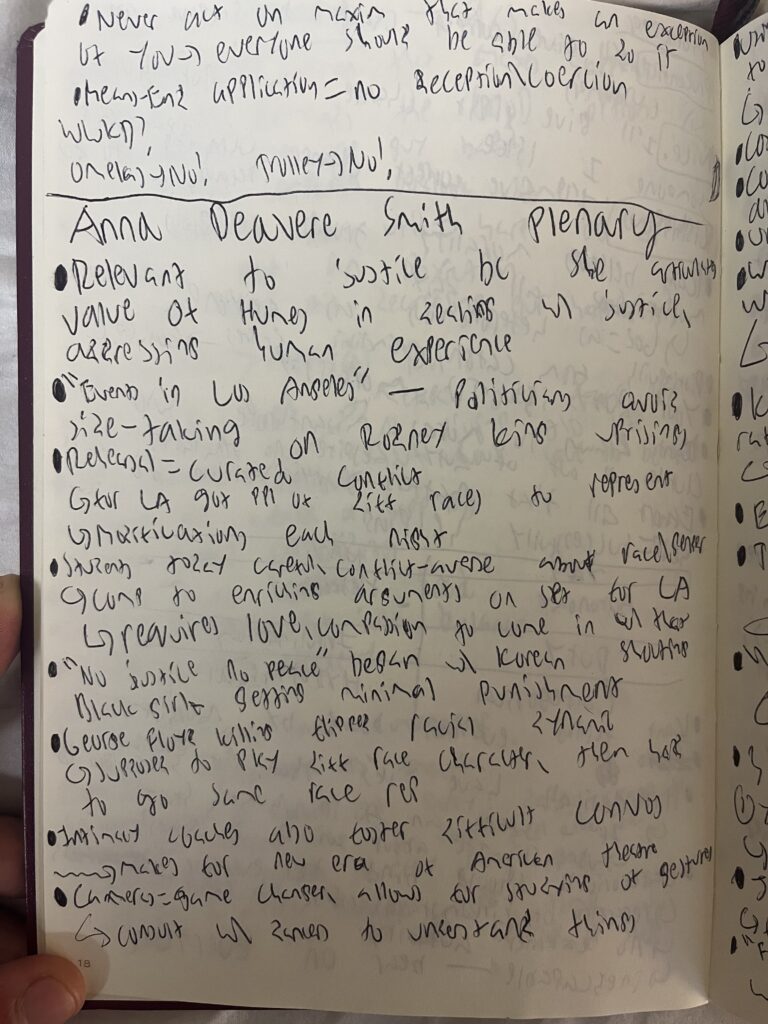
The radically inclusive nature of justice is exciting; however, it is also imposing. Nobody can credibly claim to be exempt. As Peter Singer contends in “Famine, Affluence and Morality,” “if it is in our power to prevent something very bad from happening, without thereby sacrificing anything else morally significant, we ought, morally, to do it” (235). Fortunately for our hopes of justice and unfortunately for our busy schedules, we all have the ability to stop bad things and promote good things. This year, from “Mourner’s Bench” physically illustrating the horrors of lynching via dance to Savannah Shange conducting ethnographic research while imparting wisdom in a San Francisco school to everyday people participating in lunch counter sit-ins during their midday breaks, we have seen people act in service of justice from unconventional places. Given that malleability of justice, none of us can credibly claim to be exempt from justice’s mandate or useless in its mission.
- Justice Demands Consistent Application
In Medea, part of what makes the eponymous protagonist’s revenge so meaningful lies in what she is willing to sacrifice: not only people she hates, like Jason, but people she loves, like her children. Filicide may be the most visceral example in the syllabus of a genuinely unwavering commitment to principles of justice; however, the idea that principles of justice should be applied evenly is not a novel one. John Rawls’s concept of the original position reinforces this idea of even application. Behind a “veil of ignorance,” where individuals do not know their own circumstances, people would choose principles of justice that are fair to all because they might end up in anyone’s position.
Consistency is crucial to increase the legitimacy of pleas for justice. For example, in his plenary on national apologies, Dr. Lipsker discussed how the US passed the Civil Liberties Act of 1988, which granted an apology and reparations to victims of Japanese internment, with the motive of legitimizing American critiques of the Soviet human rights record. Since hypocrisy undermines credibility, people (and nations) must first address their own transgressions to be able to legitimately stir justice in others. Conversely, consistent justice requires addressing present injustices without being paralyzed by the weight of past wrongs, as an overemphasis on historical memory can obscure the urgency of current issues. Masha Gessen’s article “In The Shadow of the Holocaust” reveals how the German memorialization of the Holocaust as “a unique historical atrocity” minimizes the weight of other injustices. Remembrance of past atrocities is crucial to preventing their recurrence, but it shouldn’t justify ignoring or even enabling others. Consistency in justice means treating the past and present equally, not elevating one at the expense of the other.
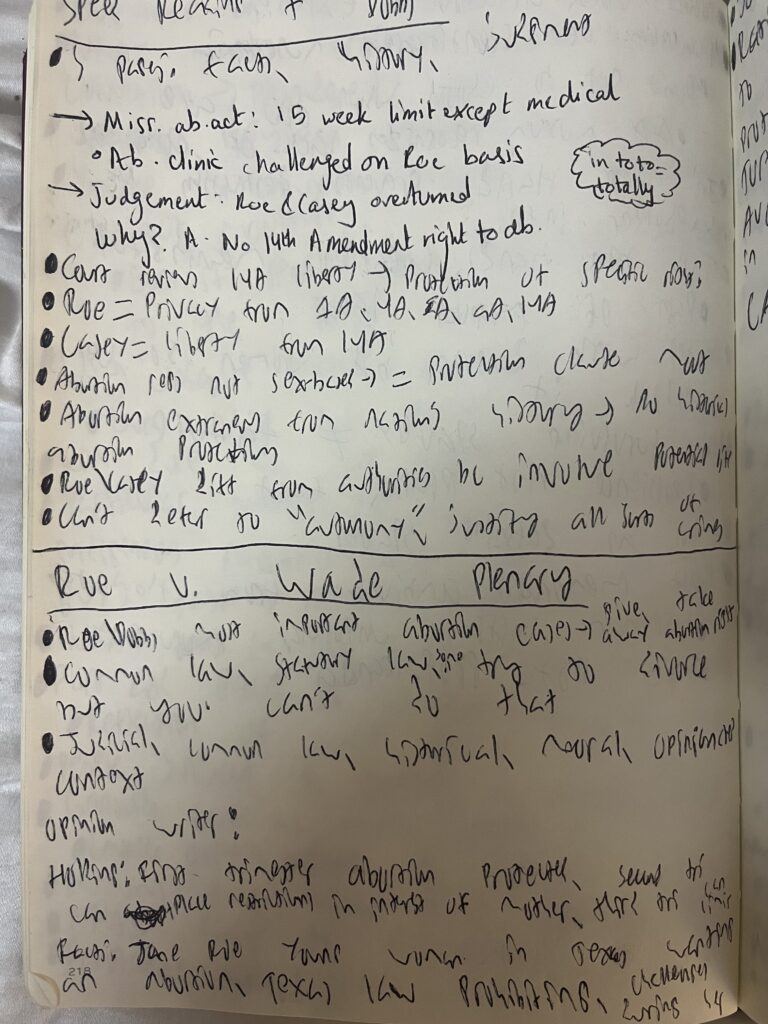
This need for consistency in justice explains one source of legal scholars’ condemnation of the Supreme Court’s decision in Dobbs v. Jackson Women’s Health Organization (2022) striking down the constitutional right to abortion established in Roe v. Wade (1973). Dobbs flew in the face of stare decisis—not only Roe, but many of its contemporaneous substantive due process cases establishing similar implicit rights. By abandoning decades of precedent, Dobbs disrupted the law’s commitment to the consistency guaranteed by stare decisis, making justice feel arbitrary and throwing into question much of the Court’s established doctrine. In neglecting stare decisis and consequently inciting mass controversy, Dobbs illustrates the importance of consistent principles of justice to the fabric of the law.
- Justice Requires Making Up For Others’ Inevitable Failures
In the final plenary of the year, Dr. Boyer rhetorically contradicted the dictionary definition of justice as a noun, instead deeming it a verb and imploring us not to look for justice, but to do it. To this end, justice requires being active to step in when others invariably neglect it. Justice is not merely abstaining from injustice, but vigorously contributing to a better world. Dour outlook and all, this is why Chris Hedges’s plenary guest lecture was inspiring. He was not only undeterred but motivated by the injustice he saw all around him, with every act of tyranny deepening his resolve to teach a class in prison or report from a war-torn country. Such an unwavering commitment to justice—even in the face of a world of injustice—is too rare. However, this desire to not just abstain but repair injustice is essential.
When other people fail, justice demands we respond with brave actions and words to reverse the effects of the initial transgression. In her plenary on dance in the AIDS epidemic, Dr. Bory drew attention to how Bill T. Jones and his partner Arnie Zane used their platforms in the dance community to correct the harmful narratives promoted by other individuals, from a person expressing concern about the dancers sweating on each other to journalist Richard Goldstein celebrating AIDS as “good for art.” By having the bravery to share their personal stories, Jones and Zane make AIDS a serious, deeply personal issue that vanquishes other individuals’ attempts to trivialize or stigmatize it. Thus, for a problem started by individuals’ damaging rhetoric, individuals also serve as the solution when they speak out and reclaim the narrative.
When institutions neglect justice, justice demands we take efforts to reform them. In 1988, ACT UP, a movement protesting government inaction addressing the AIDS crisis, recognized the Food & Drug Administration’s (FDA) unreasonably slow approval process for drugs alleviating AIDS. To resist, ACT UP held a massive protest outside the FDA’s headquarters, with thousands of demonstrators participating in a die-in to disrupt FDA operations and repudiate their ignorance of the AIDS epidemic, leading them to accelerate relevant approval processes. This represents a powerful model for bringing evolutionary institutional change: through public pressure and unwavering persistence, we can force institutions to reckon with their ills.
When institutions fail altogether, justice demands overthrowing them. In some cases, institutions are too insulated, resilient, or powerful for reform efforts like ACT UP’s to stimulate change, leading mass outrage to fall on deaf ears. As Hedges contends in Wages of Rebellion, such a feeling of powerlessness “can inspire people to tear down the decayed structures that confine them” (19). Revolution is not an idea to hastily deploy at the first sign of trouble. However, when institutions have time and time proven themselves to be unjust, revolution serves as the final recourse for justice.
Our tools for justice are overwhelming in their multitude. The Court implores its audience to wield them bravely, creatively, and frequently. Let no injustice go unchallenged.
Court adjourned.
Works Cited
Beatty, Talley. Mourner’s Bench. Choreographed and performed by Talley Beatty, 1948.
Dobbs v. Jackson Women’s Health Organization. 597 U.S. 215. Supreme Court of the United States, 2022.
Euripides. Medea. Translated by Michael Collier and Georgia Machemer, edited by Peter Burian and Alan Shapiro, Oxford University Press, 2006.
Foster, Susan Leigh. “Choreographies of Protest.” Theatre Journal, vol. 55, no. 3, Oct. 2003, pp. 395–412.
Gere, David. How to Make Dances in an Epidemic: Tracking Choreography in the Age of AIDS. University of Wisconsin Press, 2004
Gessen, Masha. “In the Shadow of the Holocaust.” The New Yorker, 9 Dec. 2023
Hedges, Chris. Wages of Rebellion: The Moral Imperative of Revolt. Nation Books, 2015.
Kafka, Franz. The Trial. Verlag Die Schmiede, 1925.
Rawls, John. A Theory of Justice. Belknap Press, 1971.
Roe v. Wade. 410 U.S. 113. Supreme Court of the United States, 1973.
Shange, Savannah. “Play Aunties and Dyke Bitches: Gender, Generation, and the Ethics of Black Queer Kinship.” The Black Scholar, vol. 49, no. 1, 2019, pp. 40–54.
Singer, Peter. “Famine, Affluence, and Morality.” Philosophy and Public Affairs, vol. 1, no. 3, spring 1972Sophocles, et al. Antigone. Penguin Classics, 2000.
Notes